
Humayun Kabir, recently suspended from the TMC, has launched a new political party, Janata Unnayan Party, and announced candidates for the 2026 assembly elections.

He also dubbed the Congress' alliance with BSP in Uttar Pradesh in 1996 as a "sell out".
The senior-most Muslim leaders of the country have appealed to all citizens to maintain peace and calm after the verdict on the Babri Masjid title suit is pronounced on September 24.

O'Romeo is an ordinary plot about a man's obsession, but Vishal Bhardwaj lays it out like a lavish spread, with stylish and very violent action set pieces, effectively used music (Bhardwaj composes Gulzar's delectable lyrics), and a romance that has moments that are tender as well as bitter, observes Deepa Gahlot.

A bench comprising Chief Justice D Y Chandrachud and Justices J B Pardiwala and Manoj Misra asked the ASI not to take recourse to any invasive act during the survey.

Asserting that he prays regularly, the CJI said, "Believe me, if you have faith, God will always find a way."
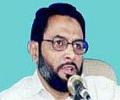
Former prime minister P V Narasimha Rao is back in the news with the All India Muslim Personal Law Board accusing him of being equally responsible for the demolition of the Babri Masjid in Ayodhya on December 6, 1992. The board went on to say that Rao could never be forgiven for the demolition of the Babri Mosque.
Congress general secretary Digvijay Singh has lashed out at Samajwadi Party chief Mulayam Singh Yadav, accusing him of trying to evoke Muslim sentiments on the controversial Babri Masjid demolition issue, to garner votes.

The court is conducting the trial of accused persons, including BJP leaders L K Advani, M M Joshi, Uma Bharti and others.

Chandrakant Patil also took a swipe at Uddhav for accusing Eknath Shinde of stealing the legacy of Bal Thackeray.
The Uttar Pradesh government also said the then prime minister P V Narasimha Rao was 'indirectly' involved in it.

Can ordinary citizens counter this backward march? Can peace activists ensure that the two communities retain their bonds? Do they have a choice, asks Jyoti Punwani.
Kalyan Singh's apology over the Babri masjid demolition, thus, is expected to assuage the Samajwadi Party's rank and file who have been upset over Yadav joining hands with him. Kalyan Singh, who subsequently left the BJP to plow a lonely furrow only to rejoin the party and again left it recently over being sidelined, has since been edging closer to the Samajwadi Party's Mulayam Singh.
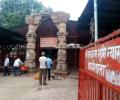
'What is at stake is not one mosque or temple, it is the question of the principle of secularism which is part of the basic structure of the Constitution as declared even by the Supreme Court of India.'
Though religion is no longer the hot topic, the government should be on its guard

Ram Vilas Vedanti, a prominent leader in the Ram Janmabhoomi movement and former Bharatiya Janata Party MP, died of a heart attack at the age of 67 in Rewa, Madhya Pradesh. His last rites will be performed in Ayodhya.
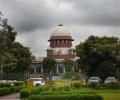
Commencing hearing on pleas challenging the constitutionality of the Places of Worship Act, 1991, the Supreme Court asked the Centre to reply to cross-pleas against or seeking implementation of statute.
The term of the Commission, set up almost soon after the 1992 Babri Masjid demolition, has now been extended till December 31
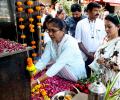
The 1993 Mumbai bombings were a series of 12 coordinated explosions across the city on March 12, 1993, killing 257 people and injuring hundreds.
It accused the then chief minister Kalyan Singh of not deploying sufficient forces to protect the Babri masjid.
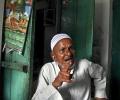
On the eve of Babri mosque demolition anniversary, Uttar Pradesh government on Friday enhanced the security of Hashim Ansari, the oldest litigant in the case, by providing him a Y category security cover.

'If the Opposition associates itself too much with the minorities, then it becomes easy for the BJP to get Hindu consolidation votes.'

What lessons opposition parties need to learn post defeat of Mamata Banerjee in West Bengal elections? The election saw spectacular victor of BJP which rose from 3 seats in 2016 to 206 seats in 2026 assembly elections.

A body representing the 'Khadims' of the Ajmer dargah has condemned a plea in a local court that seeks to declare the shrine of Khawaja Gharib Nawaz as a temple, saying right-wing forces were trying to "isolate" Muslims and "disrupt" communal harmony in the country.
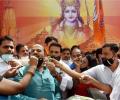
Challenging the verdict is a deterrent to future peace and harmony and a socially irresponsible act, argues Vivek Gumaste.
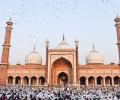
'Only because of the absence of a dedication record in writing, how can such properties be treated as located on misappropriated government land?'

Every corner of the town has a police personnel standing while various security teams such as bomb disposal squads have been deployed.

'Narendra Modi -- a man with deep and vital experience of Indian politics -- has seen the BJP lose many elections between 1975 and 2015, and with every defeat, he learned lessons that made sure he would never allow his party to be defeated so easily again.'
The Babri Masjid Action Committee (BMAC) demanded the Central Bureau of Investigation and the Centre to move applications in the Allahabad High Court for daily hearing to expedite trial and judgement in the mosque demolition case.
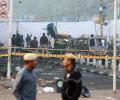
The National Medical Commission has removed several doctors from the National Medical Register following their implication in the Delhi blast investigation under the Unlawful Activities (Prevention) Act.
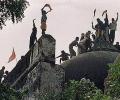
Following is the chronology of events in the 1992 Babri Masjid demolition case.

In an interview, he recalled how Hashim Ansari, one of the original litigants in the Ram Janmabhoomi-Babri Masjid dispute, took him to the mosque on his bicycle.
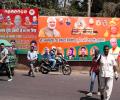
'Today, the situation in the country is bad.' 'The distance between Hindus and Muslims is increasing.' 'If an out-of-court settlement is reached, then a cordial atmosphere will prevail in the country.'

Owaisi said the CBI should appeal against the judgment "to protect its independence."

The much-awaited verdict on the title suit of the disputed site at Ayodhya will be pronounced on September 24 by the Lucknow bench of the Allahabad high court.The long pending case is about the ownership of the Ayodhya land to which Hindus and Muslims had been making rival claims over the past one and a quarter century.While Hindus claimed the land to be the site of the birthplace of their most revered Lord Ram, Muslims asserted their right over the same.
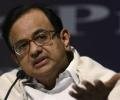
The former finance minister said he would not brush aside the incident as a mere judgemental error.
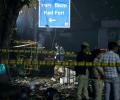
Investigations into the 'white collar' terror module busted after the recent car bombing near Red Fort showed that the mastermind Dr Umar-un Nabi had attempted to recruit a second suicide bomber but could not succeed as he backed out of the terror plot citing the need to help his family during the apple harvest, officials said on Sunday.

He hinted that the same hue and cry is not made about 1984 riots not being in textbooks.

The Allahabad high court will hear Wednesday a plea against the acquittal of all 32 accused, including Bharatiya Janata Party veterans L K Advani and Murli Manohar Joshi, in the Babri mosque demolition case.
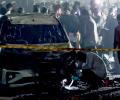
Data extracted from the mobile phone of the Red Fort suicide bomber, Dr. Umar-un-Nabi, reveals a video justifying the attack as a 'martyrdom operation'. The evidence was unearthed following the interrogation of Umar's brother, Zahoor Illahi.
